
Interpreting ABC2-SPH Risk Bands Without Overpromising
Clinicians use validated prognostic scores like ABC2-SPH to estimate in-hospital mortality risk for patients with spontaneous intracerebral hemorrhage. These tools combine clinical and imaging variables into a numeric probability that helps frame discussions with families and guide early care decisions. However, every score carries uncertainty, and its calibration in real-world populations is never perfect. The treating team must integrate the estimate with the full clinical picture rather than relying on it in isolation.
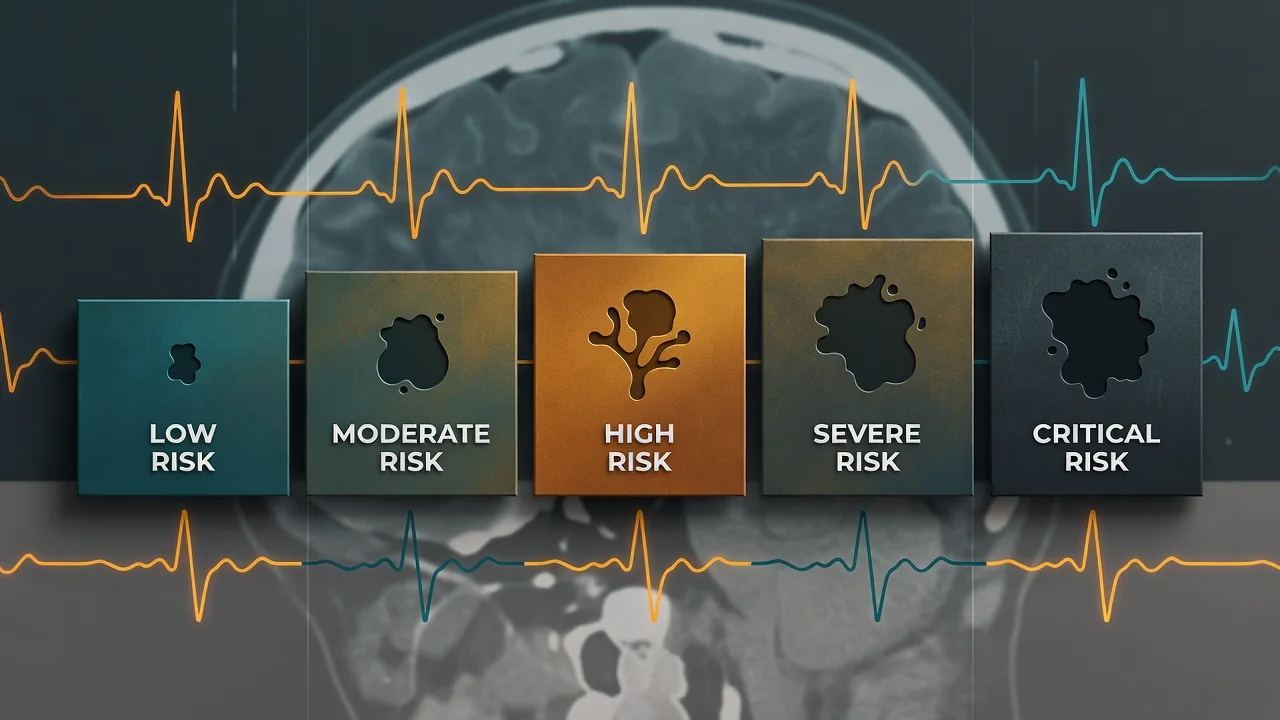
Risk bands derived from the ABC2-SPH score are typically presented as low (≤10%), intermediate (11–40%), and high (>40%) estimated mortality. These categories are derived from large derivation and validation cohorts, yet individual outcomes can deviate substantially. A patient classified as low risk may still deteriorate because of hematoma expansion, hydrocephalus, or comorbidities not captured by the model. Conversely, some individuals in the high-risk band survive with aggressive supportive care. This variability underscores why the score serves as a communication aid rather than a definitive forecast.
Understanding the Three Risk Bands
Low-risk patients (ABC2-SPH 0–2) generally have small, non-dominant hemorrhages without intraventricular extension. Families can be told that most such patients survive the acute hospitalization, although functional recovery varies. Intermediate-risk patients (score 3–5) require nuanced conversation: mortality is neither negligible nor inevitable. Discussions often focus on time-limited trials of intensive care, early do-not-resuscitate orders, and the importance of repeat imaging. High-risk patients (score ≥6) face substantial predicted mortality; here the team emphasizes goals-of-care conversations, potential transition to comfort measures, and the limited benefit of prolonged mechanical ventilation in the face of devastating brain injury. Throughout, clinicians avoid absolute language such as “will die” or “will live.”
Calibration, Uncertainty, and Bedside Judgment
Calibration refers to how closely predicted probabilities match observed outcomes across groups. ABC2-SPH performs reasonably well in broad cohorts but may over- or under-estimate risk in older patients, those on anticoagulation, or in centers with different withdrawal-of-care practices. Confidence intervals around individual predictions are wide. Therefore, the treating team always weighs the score against neurologic examination, serial imaging, comorbidities, and patient values. No model replaces repeated bedside assessment, multidisciplinary input, and shared decision-making with surrogates.
| ABC2-SPH Score | Risk Band | Typical Mortality Range | Common Clinical Language |
|---|---|---|---|
| 0–2 | Low | ≤10% | “Most patients with this profile survive hospitalization, but recovery takes time.” |
| 3–5 | Intermediate | 11–40% | “There is a real but not certain chance of death; we recommend a short trial of aggressive care while we monitor closely.” |
| ≥6 | High | >40% | “The likelihood of surviving with acceptable function is low; we should discuss what the patient would want in this situation.” |
- Always present risk in ranges rather than single percentages when speaking with families.
- Reassess prognosis at 24–48 hours with updated clinical data.
- Document both the numeric estimate and the reasoning that led to final care decisions.
- Remember that early withdrawal of life-sustaining therapy can itself influence observed mortality and calibration of the score.
Ultimately, the ABC2-SPH score is one data point within a larger conversation. It helps align expectations and reduce prognostic optimism bias, yet the responsibility for final decisions rests with the multidisciplinary treating team, informed by repeated clinical evaluation and family preferences. Used thoughtfully, risk bands support transparent, humane communication without overpromising certainty that no model can deliver.